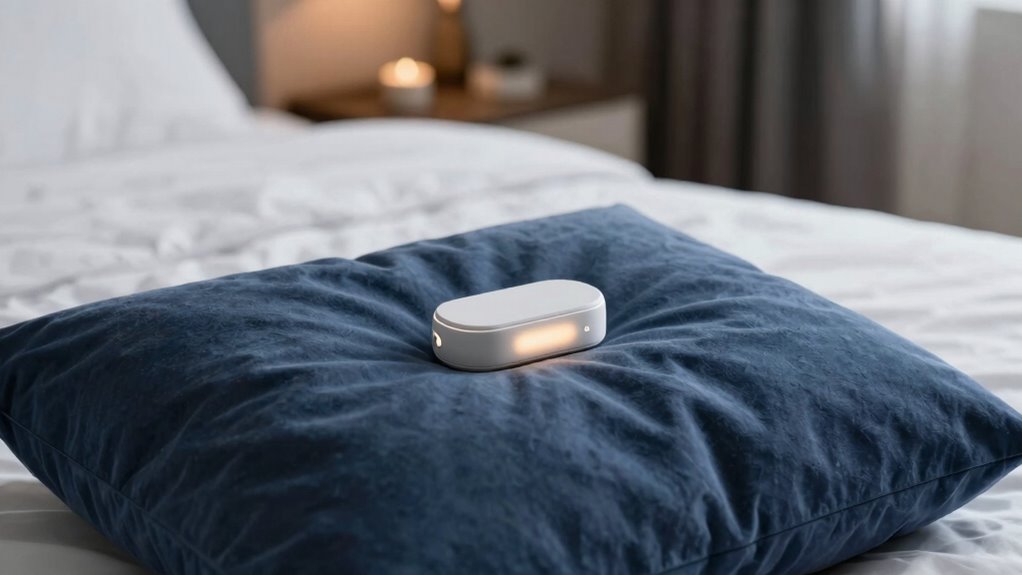

If you’re a sensitive sleeper, non-intrusive sleep trackers are your best fit. They use embedded sensors in your mattress, pillows, or nearby objects, so you don’t need to wear anything. These trackers monitor your environment—like noise, temperature, and light—to give accurate sleep data without disturbance. Their advanced algorithms learn your patterns over time, offering personalized insights. Keep exploring to discover how these innovative devices can improve your sleep quality seamlessly.

Get workout gear delivered free — and shop member deals
- Fast, free delivery on millions of items
- Access to Prime Big Deal Days deals on October 6–7
- Prime Video, Amazon Music and more included
Key Takeaways
- Non-intrusive sensors embedded in mattresses or pillows offer comfortable sleep tracking without skin contact.
- Ambient sensors monitor environmental factors like noise and light, providing valuable data without disturbance.
- Advanced algorithms analyze sleep cycles accurately while minimizing discomfort for sensitive sleepers.
- Personalized insights adapt over time, helping sensitive sleepers improve sleep quality through tailored recommendations.
- Multi-sensor systems enhance reliability, ensuring precise data collection without requiring wearable devices.

Many people want to improve their sleep but dislike wearing bulky devices at night. If you’re one of them, sleep trackers without wearables could be the perfect solution. These devices focus on monitoring your sleep environment and conducting sleep cycle analysis without the discomfort of straps, rings, or headbands. Instead, they use non-intrusive methods, allowing you to rest peacefully while gathering valuable data.
Your sleep environment plays a significant role in your overall sleep quality. Many of these trackers utilize sensors embedded in your mattress, pillows, or nearby objects to detect movement, temperature, and even sound. This setup helps create a detailed picture of how your environment affects your sleep. For example, if your room is too bright or noisy, the tracker can identify disruptions, prompting you to make adjustments like blackout curtains or a white noise machine. These subtle insights help you optimize your surroundings, leading to more consistent and restful sleep. Additionally, some systems incorporate natural sleep cycle analysis techniques to improve accuracy without direct contact with your body. These technologies often leverage ambient sensors to enhance data collection and reliability. Using advanced algorithms, these systems can interpret complex environmental data to provide more precise sleep stage detection. Incorporating multi-sensor technology can further improve the overall accuracy of these non-contact tracking systems, making them more reliable for sensitive sleepers. Moreover, many of these devices employ machine learning to adapt to your unique sleep patterns over time, offering increasingly personalized insights.
non-intrusive sleep tracker for mattress
As an affiliate, we earn on qualifying purchases.
As an affiliate, we earn on qualifying purchases.
Frequently Asked Questions
Are Non-Wearable Sleep Trackers as Accurate as Wearable Ones?
Non-wearable sleep trackers can be quite accurate for tracking sleep data, but accuracy concerns exist compared to wearable devices. While they often use advanced sensors or sound analysis to monitor sleep patterns, they may not capture all details precisely. You might find them helpful for general insights, but for detailed sleep analysis, wearable trackers usually provide more reliable data. It’s important to take into account your needs when choosing between the two.
Can Sleep Trackers Without Wearables Detect Sleep Disorders?
You can’t rely solely on non-wearable sleep trackers to detect sleep disorders, but they can signal potential issues. For example, a person notices frequent nighttime awakenings and irregular sleep patterns linked to high stress levels and a noisy sleep environment. The tracker highlights these disturbances, prompting a visit to a healthcare professional for further evaluation. It’s a helpful tool for identifying possible concerns, but diagnosis requires medical assessment.
Do Non-Wearable Sleep Trackers Require Any Setup?
Non-wearable sleep trackers usually require minimal setup; you’ll need to place the device correctly, often near your bed or under your mattress. You should check device compatibility with your smartphone or other devices, and some models may need initial calibration. Battery life varies, so make sure the tracker has enough charge for consistent monitoring. Overall, setup is straightforward, making it easy for sensitive sleepers to start tracking without fuss.
How Do Non-Wearable Trackers Monitor Sleep Stages?
Think of non-wearable sleep trackers as a silent observer, like a lighthouse scanning the sea. They monitor sleep stages through sensor placement on your bed or nearby surfaces, capturing movement and sound. The data interpretation then reveals your sleep patterns, differentiating light from deep sleep. This method relies on analyzing subtle signals, giving you insights without direct contact, ideal for sensitive sleepers seeking gentle, effective monitoring.
Are Non-Wearable Sleep Trackers Suitable for All Sleep Environments?
Non-wearable sleep trackers suit most environments, but sensor placement and environmental factors matter. You should place sensors on stable surfaces, like your mattress or nearby furniture, for accurate readings. Keep the room cool, dark, and quiet to minimize disruptions. Avoid placing sensors near electronics or drafts, as these can interfere with data. Overall, with proper setup, non-wearable trackers work well in various sleep settings.
Conclusion
Without the need to wear a device, you can still gain valuable insights into your sleep. These non-wearable trackers offer comfort and simplicity, yet deliver detailed data to improve your rest. They’re unobtrusive, gentle, and perfect for sensitive sleepers. While wearables may feel invasive, these options let you embrace restful nights without interruption. Balance comfort with awareness—because better sleep starts with knowing what your body needs, quietly and effortlessly.
Evergreen bestsellers Picks
bestsellers
As an affiliate, we earn on qualifying purchases.