TL;DR

Get workout gear delivered free with Prime
- Fast, free delivery on millions of items
- Prime Video, Amazon Music and more included
- Member-only deals all year
A Fit&Well report recommends four exercises—sit-to-stand with seated knee lifts, a dumbbell hold with a leg raise, farmer carries and shoulder presses—to work strength and balance for everyday activities. The suggested routine is two rounds, with eight repetitions per move or side and 30 seconds for each farmer carry; it is an instructor’s workout recommendation, not evidence that these exercises prevent falls or guarantee independence.
Fit&Well has published a four-exercise strength and balance routine designed around everyday tasks such as standing from a chair, carrying groceries and reaching overhead. The routine, described by a chair-workout instructor whose regular participants are in their late 60s to early 90s, uses a sturdy chair and dumbbells and calls for two rounds of the exercises.
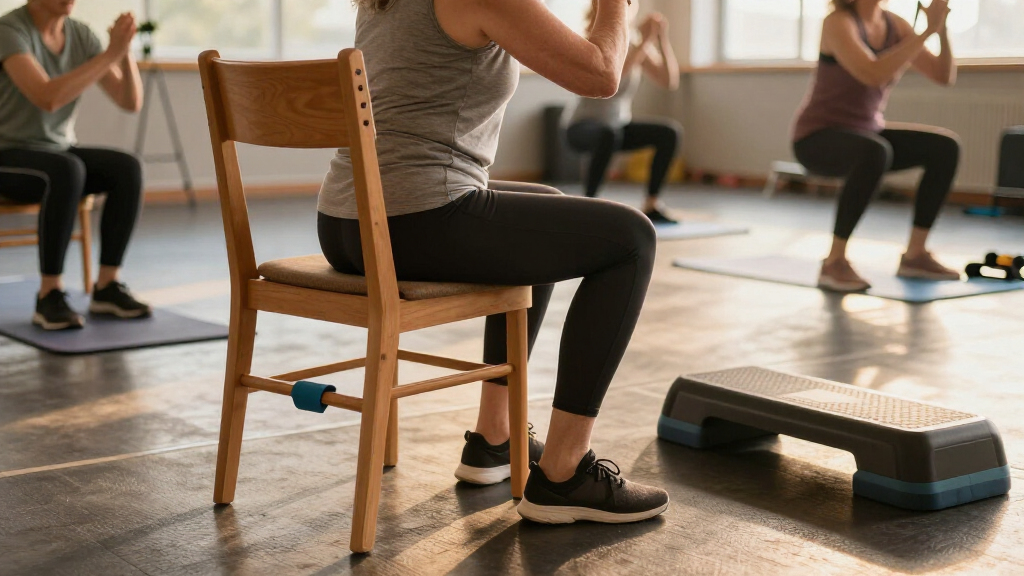
The four moves are a seated knee lift followed by a sit-to-stand, a one-sided dumbbell hold paired with a leg raise, a farmer carry and a shoulder press. The report recommends eight repetitions for each exercise, including eight on each side where applicable, and a 30-second carry. It also suggests resting for 30 seconds between farmer carries.
For the sit-to-stand combination, the participant sits near the front of a sturdy chair, lifts and lowers each leg, then stands by leaning forward slightly and pressing through the feet. The report says hands can remain on the chair for balance during the leg lifts. The one-sided leg raise is performed while holding a dumbbell in the opposite hand, with the aim of keeping the torso steady rather than leaning.
For the carry, the participant walks with a dumbbell in each hand while keeping the torso upright, then bends at the hips and knees to put the weights down. The shoulder press can be done standing or seated: weights start at shoulder height and are pressed overhead without arching the lower back. The report advises choosing weights that can be controlled comfortably throughout each movement.
Training for Everyday Tasks
The routine is framed around practical movements that can support day-to-day capability: rising from a low seat, moving the legs, carrying bags and placing objects on a high shelf. The instructor says participants in her classes want to stay independent and describes clients reporting improvements in activities such as getting into a car, walking farther and swimming longer.
Those accounts are personal examples, not controlled evidence that this specific routine produces the same results for everyone. Still, the exercises offer readers a structured way to practice several movements linked by the report to ordinary tasks, rather than focusing only on isolated muscle groups. People’s needs and starting abilities differ, so the routine should not be treated as a guarantee of independence or as a substitute for individualized advice.
As an affiliate, we earn on qualifying purchases.
The Routine and Its Rationale
The report’s instructor says her regular chair-workout participants range from their late 60s to early 90s. She connects the exercises with goals she hears from them, including walking farther, getting in and out of a car without help, carrying groceries and reaching into a cupboard. The article also argues that building strength and balance in people’s 40s and 50s may help prepare them for later-life activities; that is the instructor’s recommendation, rather than a measured result reported in the source.
Each move has a stated purpose. Knee lifts and sit-to-stands combine leg movement with standing from a seat; the one-sided leg raise challenges balance while one leg works independently; the carry practices walking while holding weight; and the press works the shoulders and arms for overhead lifting. The report says grip strength is used as a marker of overall muscle strength and has been associated with long-term health outcomes, but it does not provide a study citation or quantify that association.
The plan requires a sturdy chair and a pair of dumbbells, but the source gives no prescribed weight range, progression schedule or fitness assessment. Its instructions are a general workout suggestion, not an individualized exercise prescription.
Limits of the Exercise Advice
The source does not identify clinical research testing this exact four-move routine, nor does it establish how much strength or balance participants might gain or over what period. The instructor’s client stories are firsthand accounts; the report provides no independent assessment or comparison group.
It is also unclear whether the full routine is appropriate for every reader, including people with pain, mobility limitations, balance concerns or medical conditions. The report does not specify modifications beyond using a chair for support during the knee lifts, or explain when to increase weight or repetitions. Readers should stop if a movement causes pain and seek guidance from a qualified health professional when they have a health condition or are unsure what exercise is suitable.
Adapting the Moves Safely
The report sets out a two-round routine but gives no further timetable or follow-up plan. Readers who try it can begin with the stated comfortable, controllable weights and use the chair as described for support. Anyone who cannot perform a movement steadily should seek a suitable modification rather than pushing through it.
Before using the routine as part of a longer-term plan, people with pre-existing conditions, recent surgery, persistent pain or significant balance difficulties can ask a clinician or qualified exercise professional about safe options. The source offers no promised outcomes; whether the exercises are appropriate or useful for a particular person depends on their abilities and circumstances.
Key Questions
What are the four exercises in the routine?
The routine includes a seated knee lift and sit-to-stand, a dumbbell hold with a leg raise, a farmer carry and a shoulder press.
How many repetitions and rounds does the report recommend?
It recommends two rounds, with eight repetitions per exercise or side where relevant. Each farmer carry lasts 30 seconds, followed by 30 seconds of rest.
What equipment is needed?
The report calls for a sturdy chair and a pair of dumbbells. It advises using weights that can be controlled comfortably throughout each movement, but does not specify a weight range.
Does the report show that the routine prevents falls or guarantees independence?
No. It presents an instructor’s recommendations and client anecdotes, but does not provide evidence that this specific routine prevents falls or guarantees independence.
Should everyone follow the routine as written?
Not necessarily. The report does not give individualized medical advice or detailed modifications. People with health conditions, recent surgery, pain or balance concerns should ask a qualified health professional or exercise professional about suitable movements.
Source: rss
Halloween Picks
halloween
As an affiliate, we earn on qualifying purchases.