If you need quick prep for chopping, shredding, or kneading, a food processor saves you more time by handling a variety of tasks efficiently, though cleaning can take a bit longer. On the other hand, a high-speed blender excels at quickly creating smooth, pureed textures with less cleanup, making it ideal for liquids and smoothies. To discover which appliance fits your kitchen routine best, explore the detailed differences that follow.

Get workout gear delivered free with Prime
- Fast, free delivery on millions of items
- Prime Video, Amazon Music and more included
- Member-only deals all year
Key Takeaways
- Food processors handle multiple prep tasks quickly, reducing time spent on chopping, slicing, and shredding.
- High-speed blenders rapidly create smooth purees and liquids, minimizing blending time and cleanup.
- Blenders have fewer parts and simpler cleaning, saving time on maintenance.
- Food processors may require more time for disassembly and cleaning due to multiple attachments.
- The choice depends on specific kitchen tasks; blenders excel in quick liquid blending, while processors are better for diverse prep.
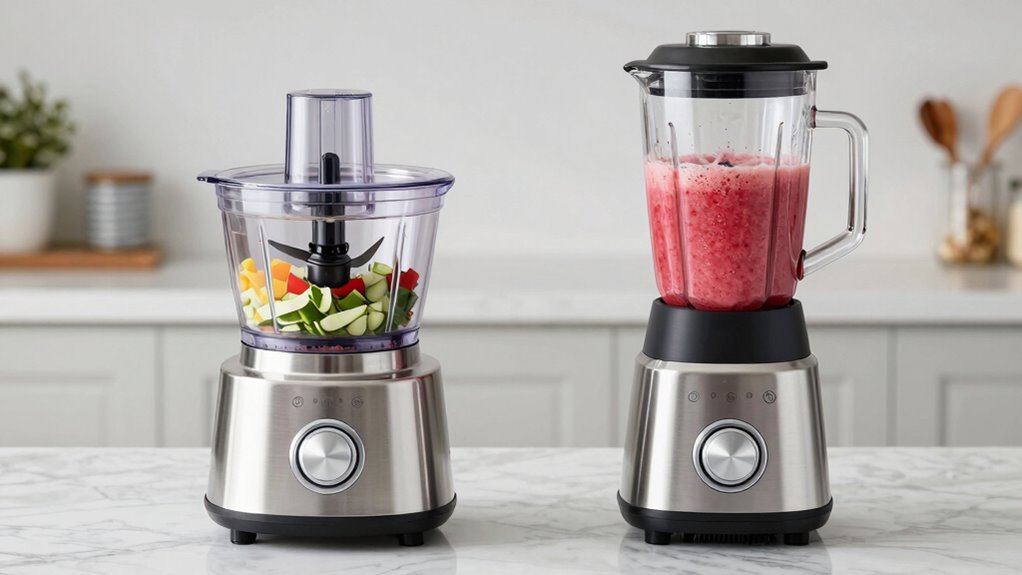
When choosing between a food processor and a high-speed blender, it’s important to understand how each appliance excels in different kitchen tasks. Both tools are invaluable for speeding up meal prep, but they serve distinct purposes that can impact your overall cooking efficiency. If you’re looking for cooking versatility, a food processor is often the better choice. It handles chopping, slicing, shredding, kneading, and even dough mixing, making it a true multitasker in the kitchen. You can prepare ingredients for a wide variety of dishes without switching tools or spending extra time on prep. In contrast, a high-speed blender specializes in creating smooth textures—think smoothies, soups, sauces, and nut butters. While it might not replace a food processor for all tasks, it excels at transforming ingredients into silky, uniform mixtures quickly.
When considering how much time you spend cleaning, the convenience of each appliance becomes just as important as their cooking capabilities. Food processors typically come with multiple attachments and blades, which can be a bit more challenging to clean thoroughly. However, many modern models feature dishwasher-safe parts that markedly reduce cleanup time. Still, you might find yourself spending a few extra minutes disassembling and rinsing components after each use. On the other hand, high-speed blenders usually have fewer parts—mainly the jar and blade—making cleaning a faster process. A quick rinse or a run with warm water and soap can usually get the job done, especially if you use the blender frequently. This cleaning convenience can save you valuable time, particularly if you prepare smoothies or soups often. Additionally, understanding color accuracy in your appliances can help ensure the consistency of your blended or processed ingredients, especially if you are aiming for specific visual results in your dishes. Moreover, choosing appliances with easy-to-clean features can further enhance your kitchen efficiency, saving you even more time during cleanup. Some models also offer self-cleaning functions, which can significantly reduce the effort needed for maintenance. Incorporating appliances with quick-clean options can further streamline your routine, especially during busy mornings. Being aware of these features can help you select appliances that align with your time-saving goals.
In terms of saving time overall, a food processor can cut down prep work for many ingredients, especially when you’re making complex dishes that require chopping or shredding. However, if your focus is on blending liquids or pureed foods, a high-speed blender can get the job done faster with less cleanup. Ultimately, your choice depends on your cooking style and how much time you’re willing to spend on cleanup. Both appliances are designed to streamline your kitchen routines, but they do so in different ways. If you want a versatile tool that can handle a wide range of tasks, a food processor is your best bet, even if it requires a bit more effort to clean. If speed and ease of cleaning are your priority, especially for liquid-based recipes, a high-speed blender might save you more time overall. Recognizing the specific functions of each appliance can help you make the most efficient choice for your kitchen needs.
best food processor for chopping and shredding
As an affiliate, we earn on qualifying purchases.
As an affiliate, we earn on qualifying purchases.
Frequently Asked Questions
Which Appliance Is Quieter During Operation?
You’ll find that a high-speed blender generally offers quieter operation compared to a food processor. In noise comparison, blenders tend to produce less sound, making them more suitable if you want quiet operation, especially early in the mornings. Food processors, with their powerful motors and chopping blades, often generate louder noise during heavy use. So, if quietness matters most, a high-speed blender is your best bet.
Can They Both Handle Hot Ingredients Safely?
Did you know that about 80% of food processors and high-speed blenders are designed to handle hot ingredients safely? You can confidently use both appliances for hot soups or sauces, but always check their safety guidelines first. Hot ingredient safety is essential for appliance durability, as extreme heat can damage internal components. So, when used correctly, both tools are durable and versatile for hot ingredient prep.
Which Is Easier to Clean After Use?
You’ll find that a food processor is generally easier to clean because it has fewer parts and a more straightforward design, making maintenance simplicity a breeze. A high-speed blender’s pitcher and blades can be trickier to wash thoroughly, especially if ingredients stick. Overall, if cleaning ease matters most to you, a food processor offers quicker, simpler maintenance, saving you time and effort after each use.
Do They Both Come With Multiple Speed Options?
Yes, both appliances often come with multiple speed options. This feature gives you better texture control, allowing you to blend or process ingredients to your desired consistency. The high-speed blender generally offers more powerful motor options, making it easier to achieve smooth purees or fine textures. The food processor may have fewer speeds but still provides essential options for chopping, slicing, and kneading, giving you versatility based on your needs.
Are Replacement Parts Readily Available for Both?
You might think replacement parts are a hassle, but surprisingly, they’re often easy to find. Both appliances from popular brands usually offer readily available replacement parts, backed by solid warranty coverage. Brand availability plays a big role here—famous brands tend to stock parts longer. So, you won’t be left in the lurch when a blade or seal needs replacing. Ironically, maintaining these appliances is simpler than you’d expect, thanks to widespread support.
Conclusion
Ultimately, choosing between a food processor and a high-speed blender depends on your specific needs. While some believe blenders save more time by quickly pureeing ingredients, research suggests that food processors, with their versatility, can actually streamline multiple prep tasks faster overall. So, don’t just rely on assumptions—evaluate your routine and try both to see which truly enhances your kitchen efficiency. After all, mastering your tools might be the real secret to saving time.
Halloween Picks
halloween
As an affiliate, we earn on qualifying purchases.