TL;DR

Get workout gear delivered free — and shop member deals
- Fast, free delivery on millions of items
- Access to Prime Big Deal Days deals on October 6–7
- Prime Video, Amazon Music and more included
A study published in Frontiers in Aging reports unusually high late-life survival among women in Bolotana, Sardinia. Researchers estimate that 13.8% of women there who reach 70 will live to 100, but the study does not establish why they live so long.
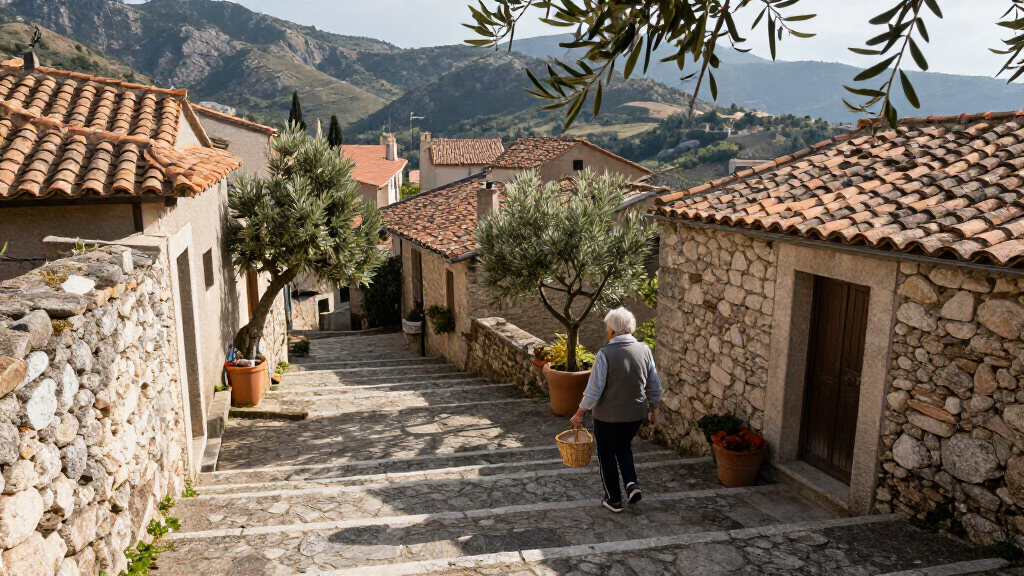
A study of Bolotana, a Sardinian village, estimates that women who reach age 70 there are much more likely to live to 100 than women in Italy or the United States. The findings, published in Frontiers in Aging, raise the possibility that the community could qualify as a newly identified longevity hotspot, though the research does not explain the causes of its survival pattern.
The researchers examined demographic records from Bolotana, a village of about 2,300 residents, and reconstructed life histories using civil records and church archives. Their analysis included people born in the village between 1900 and 1925. It documented 38 centenarians among 3,060 births in that group.
For women who reached 70, the team estimated a 13.8% chance of reaching 100. The comparable estimates were about 3.5% for women in Italy and 3.6% for women in the United States. These figures describe the probability of surviving from age 70 to 100; they are not a claim that 13.8% of all Bolotana women live to 100.
According to the report, six residents aged 100 or older were living in Bolotana in 2024. The researchers estimated that this represented a prevalence roughly 11 times that of the United States. The study team checked ages against birth, death and baptismal records, drawing on archives that extend back centuries.
Why Bolotana’s Records Matter
The finding gives aging researchers a small community in which to investigate exceptional survival in later life. Reliable ages matter because claims about extreme longevity can be difficult to assess when records are incomplete or inconsistent. The team’s use of multiple archival sources offers a way to study the pattern with greater confidence in residents’ recorded ages.
The results also distinguish Bolotana from the better-known longevity area elsewhere in Sardinia. Researchers have previously associated the island’s original blue zone with unusually high male longevity. In this study, women were the standout group: those reaching 70 were estimated to have nearly 21 additional years of life expectancy. The researchers placed Bolotana women second to Hong Kong on international benchmarks for life expectancy at 70 and survival to 100.
That comparison makes the village relevant to researchers studying differences in aging across populations. It does not show that people elsewhere can reproduce Bolotana’s outcomes by adopting one particular habit. The study identifies a survival pattern; explaining it, and determining how much it can inform health practices beyond the village, will require further research.
longevity dietary supplements for women
As an affiliate, we earn on qualifying purchases.
As an affiliate, we earn on qualifying purchases.
A New Sardinian Longevity Pattern
The idea of a “blue zone” grew from research into communities where residents appear to live unusually long lives compared with people in nearby areas. Okinawa in Japan and the Nicoya Peninsula in Costa Rica are among places previously identified by researchers. Sardinia has also drawn attention for longevity, but the established Sardinian pattern has been associated especially with men.
Bolotana came to researchers’ attention because of its concentration of centenarians. The team then examined whether that observation held up across a larger historical record. It assessed life expectancy at age 70 and the likelihood of surviving from 70 to 100, rather than relying only on the number of very old residents present at one point in time.
The study, by Giovanni Mario Pes and colleagues, appeared in Frontiers in Aging in 2026. S. Jay Olshansky, professor emeritus of epidemiology at the University of Illinois Chicago School of Public Health and a co-author, said the municipal and baptismal records allowed researchers to independently check ages. The report describes the analysis as a deeper review of more than a century of records.
““What makes Bolotana extraordinary is that it has an incredible historical record that allows us to definitively evaluate ages at birth and death.””
— S. Jay Olshansky, study co-author
What Drives Survival in Bolotana
The study does not identify why Bolotana’s older residents survive at these rates. Olshansky pointed to walkable streets, locally produced food, family support and social connection as clues for future work. The researchers also consider genetics a possible factor. The reported analysis does not establish how much any one of these influences contributes, or whether they explain the difference from national estimates.
The findings are based on a specific village and historical birth cohorts. The estimates do not show whether the same survival pattern applies to residents born more recently, or whether it would be found in other Sardinian communities. The published report also does not establish that any particular diet, activity or social practice can cause people elsewhere to live longer.
Bolotana may represent a newly identified blue zone, but that label remains a possibility raised by the findings. Further research would need to examine the pattern and its potential explanations before drawing broader conclusions. The study’s validated records address uncertainty about ages; they do not settle uncertainty about the causes of longevity.
Research Into Local Factors
The next step is to investigate the factors that may be associated with Bolotana’s late-life survival. Researchers can examine the possible roles of diet, daily movement, family and community ties, and genetics, while distinguishing observed characteristics from causes supported by evidence.
The current report does not set out a specific follow-up timetable or announce another study. For now, its contribution is a documented pattern based on historical records and a set of questions for further research. Whether Bolotana is formally recognized as a blue zone, and which features of village life matter most, remain open.
Key Questions
What did the study find about women in Bolotana?
Researchers estimated that 13.8% of women who reach age 70 in Bolotana will live to 100. The comparable estimates in the study were about 3.5% for women in Italy and 3.6% for women in the United States.
How did the researchers check residents’ ages?
The team compared birth, death and baptismal records from municipal and church archives to validate the ages of people who reached 100.
Has the study explained why residents live so long?
No. The study reports an unusual survival pattern but does not establish its causes. Researchers have identified possible factors, including walking, local food, social ties and genetics, for further investigation.
Is Bolotana officially a blue zone?
The findings suggest Bolotana could be a newly identified blue zone. The report presents this as a possibility; it does not say the label has been formally confirmed.
Source: rss
Halloween Picks
halloween
As an affiliate, we earn on qualifying purchases.